
Söring
S185 & S300
Ultrasonic dissection and wound debridement
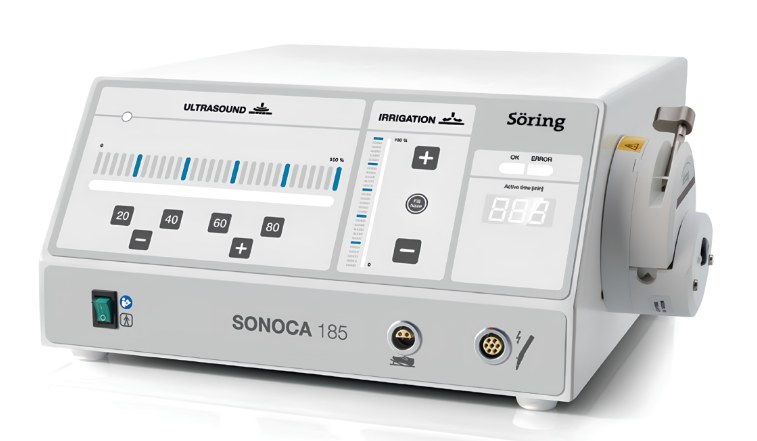
Söring ultrasonic platforms for tissue-selective dissection and wound cleansing. The S185 focuses on ultrasonic wound debridement while the S300 delivers parenchymal dissection for liver and other solid organ surgery.
- Tissue-selective dissection preserves vessels and ducts
- Reduced blood loss in parenchymal resection
- Ultrasonic debridement for chronic and infected wounds
Overview
About this product
Söring's ultrasonic technology exploits the difference in water content between tissue types. Cells with high water content fragment under ultrasonic cavitation, while collagen-rich structures such as vessels, bile ducts and nerves are comparatively resistant — allowing the surgeon to clear parenchyma while skeletonising the structures that must be preserved.
The S300 is the surgical platform: a generator, handpieces and a range of sonotrodes for open and laparoscopic dissection in hepatobiliary, pancreatic, renal and neurosurgical work, with integrated irrigation and aspiration to keep the field clear.
The S185 applies the same principle to wound care. Low-frequency ultrasound delivered through an irrigation film cleanses chronic and infected wounds, disrupting biofilm and removing fibrin and necrotic tissue with less pain than sharp debridement, in theatre or at the bedside.
Features
Key features and benefits
Tissue selectivity
High-water-content parenchyma fragments while collagen-rich vessels and ducts are preserved for controlled ligation.
Integrated irrigation and aspiration
Continuous irrigation cools the sonotrode and clears debris, maintaining visibility during dissection.
Sonotrode range
Open, laparoscopic and wound-care sonotrodes cover dissection, fragmentation and debridement.
Biofilm disruption
Low-frequency ultrasound in the S185 breaks up biofilm and fibrin that sharp debridement leaves behind.
Clinical use
Applications and indications
Liver and pancreatic resection
Parenchymal transection with vessel and duct preservation, supporting reduced intra-operative blood loss.
Neurosurgery and urology
Controlled tissue fragmentation adjacent to critical structures.
Chronic and infected wounds
Diabetic foot ulcers, venous leg ulcers, pressure injuries and infected surgical wounds.
Burns and trauma wound preparation
Wound bed preparation before grafting or negative pressure therapy.
- Hepatobiliary and pancreatic resection
- Neurosurgical and general dissection
- Chronic wound debridement
Specifications
Specifications, sizes and models
- Technology
- Low-frequency ultrasonic cavitation
- S300
- Surgical dissection platform, open and laparoscopic
- S185
- Ultrasonic wound debridement platform
- Irrigation
- Integrated irrigation and aspiration
- Mobility
- Cart-mounted, theatre and bedside use
Available sizes & models
S300 generator
Capital unit with handpiece and footswitch
S185 generator
Wound care unit for theatre, ward and clinic
Sonotrodes
Straight, curved, laparoscopic and wound-care tips
Consumables
Irrigation sets, tubing and sterile covers
Technical
Important technical information
- Match sonotrode selection to the tissue plane and access route; laparoscopic tips require the corresponding handpiece.
- Maintain irrigation flow during activation — dry activation damages the sonotrode and heats surrounding tissue.
- Amplitude settings should be titrated to tissue type rather than run at maximum by default.
- Sonotrodes have a defined reprocessing and lifetime limit; track usage per the supplier's instructions.
- Annual preventive maintenance and electrical safety testing are recommended for the generator.
This page is a clinical summary for healthcare professionals. Always refer to the manufacturer's instructions for use for full indications, contraindications, warnings and handling requirements.
Related
Related products
More in Surgical Technology