
Ortholox
Ortolog Cables
Sternal closure cable system
A cable-based sternal closure system engineered to distribute load evenly across the sternum, providing secure fixation after median sternotomy.
- Even load distribution reduces bone cut-through risk
- Consistent, reproducible tensioning
- Designed for routine and high-risk sternotomy closure
Overview
About this product
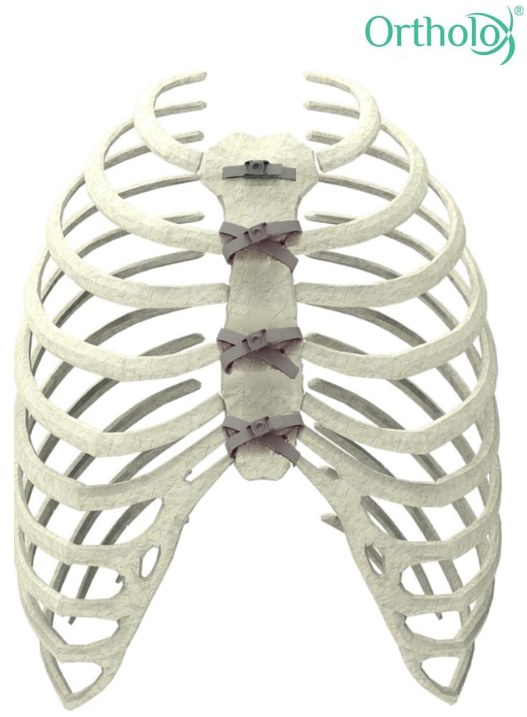
Ortolog Cables replace conventional stainless steel wire with a multi-filament cable that spreads closure force over a broader bone surface. Where a single-strand wire concentrates load on a narrow contact line, the braided cable conforms to the sternal cortex and reduces the peak pressure that drives cut-through in osteoporotic, obese or re-operative patients.
Each cable is supplied pre-mounted to a swaged needle and paired with a crimp lock, so the surgeon can pass, tension and secure the closure in a reproducible sequence. Tension is applied with a dedicated tensioner and captured mechanically by the lock, removing the variability of hand-twisted wire knots.
The system is designed to sit flat against bone, minimising palpable prominence and soft-tissue irritation, and is fully compatible with standard sternal re-entry techniques should re-operation be required.
Features
Key features and benefits
Multi-filament cable construction
Braided strands flex around the sternal edge and distribute closure force over a wider footprint than single-strand wire.
Mechanical crimp lock
Tension set by the tensioner is captured by the lock, so closure force does not depend on knot technique.
Low-profile fixation
Cable and lock sit close to bone, limiting palpable hardware and soft-tissue irritation in thin patients.
Re-entry friendly
Cables can be cut and removed with standard instruments if sternal re-entry becomes necessary.
Clinical use
Applications and indications
Routine median sternotomy
Primary closure after coronary artery bypass grafting, valve surgery and aortic procedures.
High-risk sternal closure
Osteoporotic bone, elevated BMI, diabetes, COPD and other patients at raised risk of sternal dehiscence.
Re-do and revision surgery
Re-closure after sternal re-entry, including cases with existing bone loss or previous wire cut-through.
- Median sternotomy closure
- High-risk and re-do sternal closure
Specifications
Specifications, sizes and models
- Implant material
- Implant-grade metal cable with matched crimp lock
- Delivery
- Cable pre-attached to a swaged needle
- Fixation
- Mechanical crimp, tensioner-controlled
- Sterility
- Supplied sterile, single use
- Imaging
- Radio-opaque; visible on chest radiograph
Available sizes & models
Standard cable
Single peristernal cable for routine closure
Cable set
Multi-cable pack covering a full sternotomy closure sequence
Instrument set
Reusable tensioner and crimper supplied for theatre sterilisation
Technical
Important technical information
- Place cables peristernally or transsternally according to bone quality and surgeon preference; a typical closure uses five to seven cables.
- Apply tension progressively and symmetrically from the manubrium downward to avoid shear at the sternal midline.
- Crimp only once tension is confirmed — a crimped lock is not intended to be re-tensioned.
- Trim excess cable and turn the free end away from the skin to avoid soft-tissue irritation.
- Reusable instruments must be cleaned and sterilised in line with the supplier's reprocessing instructions.
This page is a clinical summary for healthcare professionals. Always refer to the manufacturer's instructions for use for full indications, contraindications, warnings and handling requirements.
Related
Related products
More in Cardiothoracic